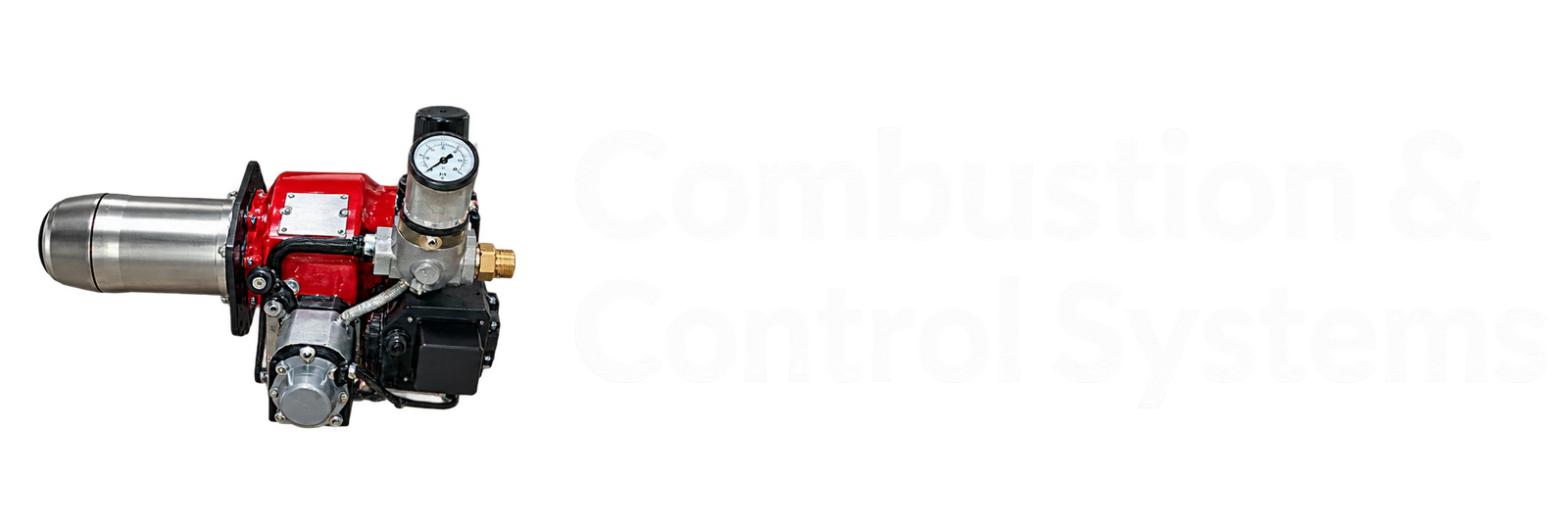
A Riello gas burner gas train is the set of parts that brings gas from your supply pipe to the burner safely and at the right pressure. On a Riello 40 FS gas burner it includes a manual cock, a filter, a gas pressure switch, a pressure regulator and the solenoid valves, such as the Brahma EG12 SR GMO. The burner’s control box opens the valves only when every safety check has passed, and closes them the moment something goes wrong.

What is a Riello gas burner gas train?
Think of the gas train as the burner’s fuel line with built-in safety. The burner itself mixes gas and air and holds the flame. The gas train, on the other hand, decides whether gas can reach the burner at all, and at what pressure.
Riello’s manuals for the 40 FS series show the gas train as a separate assembly that is connected to the burner. It plugs into a dedicated socket on the burner, so the control box can power the valves and read the pressure switch. Riello also states that the gas train should comply with the European standard EN 676 for gas burners.
In simple words, a good gas train does three jobs:
- It keeps dirt and rust out of the valves and the combustion head.
- It holds the gas pressure steady, so the flame stays stable.
- It shuts the gas off instantly when the burner stops or the flame fails.
Which parts make up the gas train?
The Riello 40 FS5 manual lists the gas feeding line in this order, from the supply pipe to the burner. The manual cock and the pressure gauge are the installer’s responsibility; the rest form the gas train itself.
| Part | What it does | What happens if it fails |
|---|---|---|
| Manual cock (gas cock) | Lets you isolate the burner by hand for maintenance | You cannot shut off gas safely for repairs |
| Gas pressure gauge | Shows the supply pressure before the train | Pressure problems go unnoticed |
| Gas filter | Traps dust, rust and pipe scale | Dirt reaches the valve seats and the valves may leak or stick |
| Gas pressure switch | Confirms there is enough gas pressure to start | Burner will not start, or starts on too little gas |
| Safety valve | First solenoid valve; shuts off gas on any fault | Loss of a key safety barrier |
| Pressure regulator (stabiliser) | Keeps outlet pressure steady even when supply pressure changes | Flame becomes unstable, sooty or lifts off |
| Adjustment (working) valve | Opens to feed gas to the combustion head | Burner tries to start but never lights |
The manual also shows two test points. One measures the gas supply pressure, and the other measures the pressure at the combustion head. Technicians use these when they set up or service the burner.
How does the gas train work when the burner starts?
Every start follows the same safety sequence. Here is what happens, step by step:
- Heat demand. The boiler or oven thermostat calls for heat, and the control box starts its checks.
- Gas pressure check. The gas pressure switch must confirm that supply pressure is present.
- Pre-purge. The fan runs to clear the combustion chamber, and the air pressure switch on the burner confirms that air is flowing.
- Ignition. The ignition electrode starts sparking.
- Valves open. The control box powers the solenoid valve coils, and gas flows to the head.
- Flame check. The ionisation probe must detect the flame within the safety time. If it does not, the valves close and the burner goes into lockout.
As a result, gas only flows when the burner is ready to burn it. That is why the gas train is as much a safety system as a fuel line. For more on lockouts, see our guide on why a Riello burner keeps going into lockout.
Where does the Brahma EG12 solenoid valve fit in?
On the Riello 40 FS10 and FS20 burners we offer with a Brahma valve, the solenoid valve on the gas train is a Brahma EG12 SR GMO. It is a 1/2 inch, normally closed valve. In other words, it stays shut whenever its coil has no power.
So when the control box cuts power after a flame failure, the valve closes by itself. This fail-safe action is exactly what the gas train needs. You can read about its coil, the SR and L types and fault signs in our Brahma EG12 SR GMO valve guide.
We supply the Riello 40 FS10 and FS20 gas burner with the Brahma EG12 SR GMO valve, and the Brahma EG12 SR GMO valve on its own as a spare.
Multibloc or separate valves: what is the difference?
A gas train can be built in two ways.
- Multibloc (compact) train. The filter, pressure switch, valves and regulator sit in one body. Riello’s manuals list Dungs MB-DLE multiblocs as standard gas trains for the 40 FS series. A multibloc is compact and quick to fit. See the Dungs MB-DLE 407 B01 S20 multibloc.
- Separate-component train. Each part is a separate item piped in a line: filter, regulator, pressure switch and solenoid valves such as Brahma or Elektrogas. It takes more space, but you can replace one faulty part instead of the whole block.
Both work well when sized correctly. However, the train must match your gas type (PNG or LPG), your supply pressure and your burner’s output. An undersized train starves the burner, while a wrong regulator spring gives the wrong outlet pressure.
How do you check a Riello gas burner gas train safely?
Gas work should always be done by a trained technician. That said, operators can watch for warning signs during daily rounds:
- Smell of gas near the train. Shut the manual cock, ventilate the area and call a technician immediately.
- Pressure gauge reading lower than usual, which may point to a choked filter or a supply problem.
- Burner fails to start after a gas supply change or cylinder bank changeover.
- Humming coil but no flame, often a stuck valve.
- Flame that pulses or changes colour, which can mean the regulator is not holding pressure.
During a service visit, the technician should clean or replace the filter, check the gas pressure switch setting, test the valves for tightness and measure pressures at the test points. Riello recommends a burner check at least once a year.
Buy Riello gas burner gas train parts in Mumbai
Riello industrial oil and gas burners supplies Riello 40 FS gas burners, Brahma and Elektrogas gas solenoid valves, Dungs gas train parts, Vanaz gas pressure regulators and other burner spares from Gala No. 204, B Block, Prime Trade Center, Waliv Phata, Sativali Road, Vasai (E) – 401208, Maharashtra.
To get the right part the first time, send us:
- Your burner model, from the rating plate
- Your gas type: PNG (natural gas) or LPG
- A clear photo of the existing gas train and the label on each valve
WhatsApp us for the price of Riello gas burner gas train parts.
Frequently asked questions
Is the gas train supplied with a Riello gas burner?
Riello’s manuals describe the gas train as a separate assembly from the burner. When you ask for a quote, confirm whether the gas train is included.
Why are there two solenoid valves on a gas train?
Two valves in series give double protection. If one valve fails to close fully, the second still stops the gas.
Can I use the same gas train for LPG and PNG?
Not always. The regulator setting and supply pressure differ between LPG and natural gas, so the train must suit your gas. Ask a technician before switching fuels.
What does the gas pressure switch do?
It confirms there is enough gas pressure before the burner starts. If pressure drops, it stops the burner from firing.
Can I replace only one part of the gas train?
On a separate-component train, yes. On a multibloc, many faults mean replacing the block, although some coils can be changed alone.