Gas solenoid valve not working? In most cases the valve body is fine and the real cause is no power at the coil, a burnt coil, a blocked filter or the wrong gas pressure. A valve that will not close is different: that is a safety fault, so stop the burner and isolate the gas straight away. Here is how to tell the two apart and what to check.
How does a gas solenoid valve work on a burner?
A burner gas solenoid valve is normally closed. It stays shut until the burner control box sends power to its coil. The coil then lifts the plunger, and gas flows to the burner head. As soon as the power is cut, a spring pushes the plunger back down and the valve shuts.
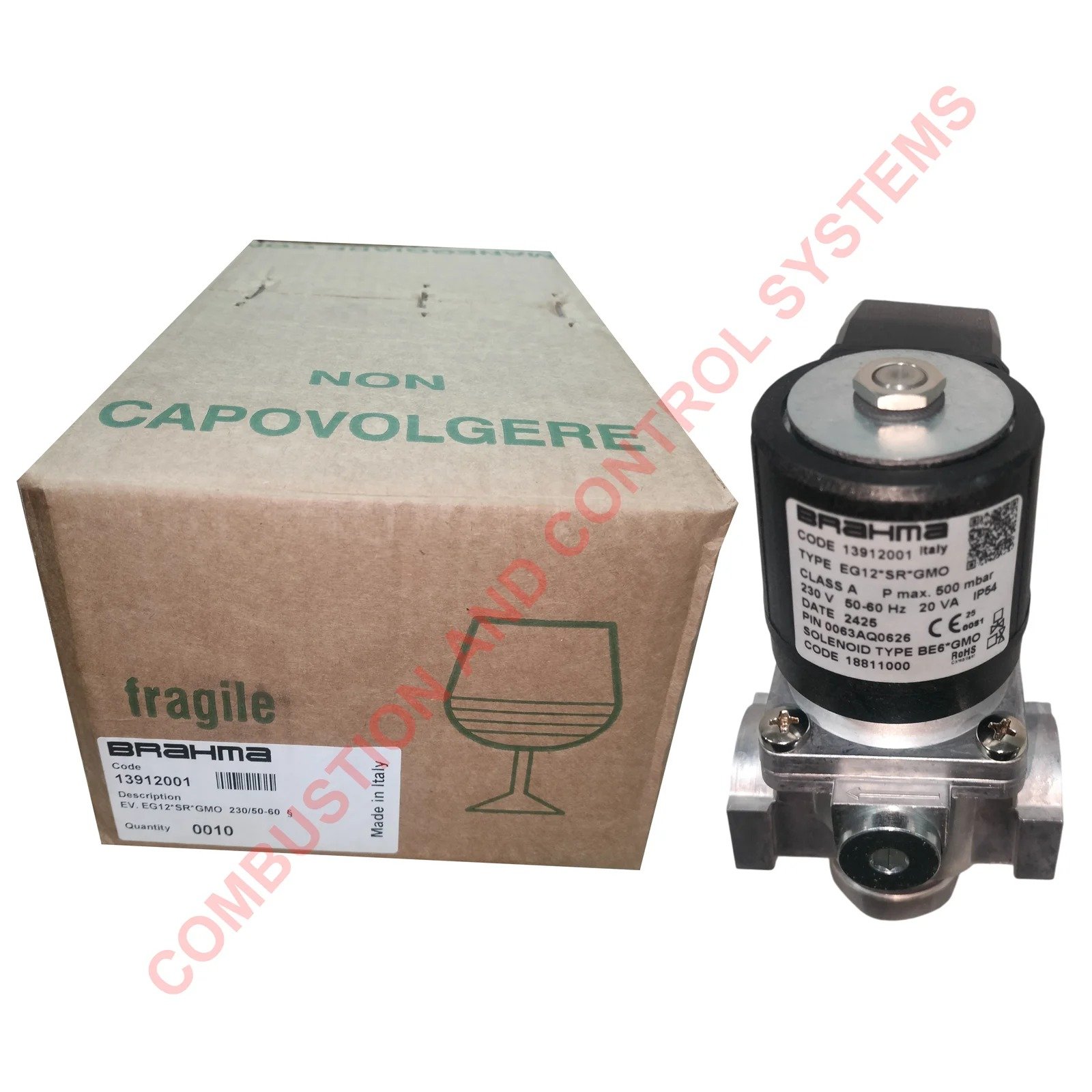
Take the Brahma EG12 series, which is fitted to many small gas burners, including Riello 40 FS models. Brahma’s data sheet describes it as a Class A, normally closed valve that closes in 1 second or less, with 230 V and 110 V coil versions. So a valve that does not open just stops the burner, while one that does not close can let gas through.
For the full gas line, see our guide to the Riello gas burner gas train with Brahma EG12 valve.
Why is my gas solenoid valve not working?
When a valve fails to open, the burner normally runs its full start sequence. The fan starts, pre-purge finishes and the spark comes on, but no gas reaches the head. As a result, no flame forms and the control box goes into lockout. Typical signs are:
- The fan and ignition spark work, but there is no flame
- There is no click from the valve at the moment of ignition
- The gas pressure gauge does not move when the valve should open
The table below lists the usual reasons a gas solenoid valve is not working, starting with the most common.
| Cause | What you notice | What to check |
|---|---|---|
| No power at the coil | Valve is silent at ignition | Control box output, wiring, plug and fuses |
| Wrong or low voltage | Weak click, humming, valve opens only sometimes | Supply voltage against the coil label (230 V or 110 V) |
| Burnt or open coil | Coil discoloured or smells burnt, no magnetic pull | Coil resistance with the power off |
| Blocked filter | Weak, unstable flame or no flame at all | Gas train filter and the valve’s inlet strainer |
| Inlet pressure too high | Valve stays shut or opens noisily | Supply pressure against the maximum on the valve label |
| Plunger stuck by dirt | Correct voltage, good coil, still no gas | Valve replacement |
Lockout has other causes too, such as a dirty ionisation probe. See our guide on Riello burner lockout causes and fixes.
Gas solenoid valve not working? Check it safely, step by step
Electrical tests on a live burner panel must be done by a qualified technician or electrician. With that in mind, this is the usual order of checks:
- Confirm gas is available. The manual isolating valve should be open and the inlet pressure gauge should show normal supply pressure.
- Listen at ignition. A healthy valve gives a clear click when the control box powers it. Do not pull the coil off while it is powered, because that can burn it out.
- Measure the voltage at the coil during ignition. It should match the coil label. A common rule of thumb in solenoid valve troubleshooting guides is that it should not fall below about 85% of the rated voltage.
- Test the coil with the power off. A resistance reading of zero or an open circuit means the coil has failed.
- Check filters and pressure. A choked filter or a supply pressure above the valve’s rating can stop it opening properly.
- Decide on the valve. If the voltage, coil and pressure are all correct but no gas flows, the valve itself is faulty and should be replaced.
What if the gas solenoid valve is not closing?
This is the dangerous failure. A valve that does not seal fully lets gas pass when the burner is meant to be off. Watch for these warning signs:
- The flame stays on for a moment after the burner switches off
- A smell of gas near the burner or boiler when it is idle
- The burner lights with a bang or a hard ignition
- Downstream gas pressure keeps rising while the burner is off
Common causes include dirt on the valve seat, a worn seal, a weak spring or a wiring fault that keeps the coil powered. A clean gas filter is the best protection against dirt reaching the seat.
If you suspect a valve is passing gas, close the manual gas isolating valve, switch off the burner, ventilate the area, avoid any sparks and call a qualified technician. Do not try to open up and clean the valve. Brahma states that it accepts no responsibility for damage caused by tampering with its valves, so a valve that has leaked should be replaced, not repaired.
Should you replace the coil or the whole valve?
Replace only the coil when the valve body is in good condition and the single fault is a burnt or open coil. The new coil must match the original code and voltage exactly.
On the other hand, replace the complete valve when it will not close, passes gas, sticks, has a damaged body or is simply old. Riello’s 40 FS manuals give gas valves a life of 10 years or 250,000 operating cycles, after which they should be replaced.
Before ordering, note these details from the old valve label:
- Brand and full type code, for example EG12*SR*GMO
- Coil voltage and frequency
- Connection size (1/2″, 3/4″ or 1″)
- Gas type (PNG or LPG), supply pressure and burner model
For small burners with a 1/2″ line, the Brahma EG12 SR GMO gas solenoid valve is a common fit. For 3/4″ lines, see the Elektrogas VMR2-5 DN20 gas solenoid valve. A photo of the label is the quickest way to confirm a direct replacement when your gas solenoid valve is not working.
Buy a gas solenoid valve in Mumbai
Riello industrial oil and gas burners (Combustion & Control Systems) has been in burners and combustion systems since 1996. We supply Brahma, Elektrogas and Dungs gas valves, Riello gas and oil burners and burner spare parts to plants across Mumbai and India.
Address: Gala No. 204, B Block, Prime Trade Center, Waliv Phata, Sativali Road, Vasai (E) – 401208, Maharashtra (Mumbai region).
Send a clear photo of your old valve label and your burner model, and we will help you match the right valve or coil. Ask for a gas solenoid valve price on WhatsApp.
Frequently asked questions
Can I bypass or hold open a gas solenoid valve to keep production running?
No. The valve is a safety device that shuts off gas when the flame fails or the burner stops. Bypassing it can lead to a gas build-up or explosion.
How do I know if the solenoid coil is burnt?
A burnt coil often looks discoloured or smells burnt, and it gives no magnetic pull when powered. A resistance test with the power off confirms it: zero or an open circuit means the coil has failed.
Can I use a 230 V coil on a 110 V supply?
No. The coil voltage must match the supply shown on the valve label. A mismatched coil may not open the valve or may overheat and burn out.
What should I do if my gas solenoid valve is not working and the burner is in lockout?
Reset once only. If it locks out again, check that gas is available and call a technician to test the coil voltage, the coil and the gas pressure before replacing any parts.