To choose the right oil burner nozzle, match four things to your burner: the flow rate (GPH), the spray angle, the spray pattern and the pump pressure. In short, copy the markings on your old nozzle unless the burner maker says otherwise. Get these right, and the flame stays clean, steady and smoke-free.
What does an oil burner nozzle do?
The pump pushes oil through the nozzle at high pressure. Then the nozzle breaks it into a fine mist and sprays it in a set cone. As a result, the oil mixes well with air and burns cleanly. So a worn or wrong nozzle quickly shows up as smoke, soot or lockouts.
How do I read the markings on an oil burner nozzle?
Most nozzles carry three key markings. For example, a nozzle marked “1.00 60° S” means:
- 1.00 – the flow rate, in US gallons per hour (GPH) at the test pressure
- 60° – the spray angle
- S – the spray pattern, here solid
However, letters differ between makers. For example, Danfoss marks hollow as H, solid as S and semi-solid as B. On the other hand, some makers use B for solid. So always check the maker’s chart, such as the Danfoss oil nozzle range.
1. Match the flow rate
Flow rate is the most important number. It tells you how much oil the nozzle sprays at its test pressure, usually 100 psi (about 7 bar). In practice, a higher pump pressure means more oil, and a lower one means less. Therefore, never guess the size. Instead, copy the old nozzle or follow the burner manual.
2. Choose the right spray angle
Common angles are 30°, 45°, 60° and 80°. The right angle depends on the burner head and the size of the combustion chamber. If the angle is too wide, the flame may hit the walls. If it is too narrow, the flame may be long and unstable. So keep the original angle unless a technician advises a change.
3. Pick the spray pattern
- Hollow cone: more oil at the edge of the spray. Usually, it suits small burners and low firing rates.
- Solid cone: oil spread evenly across the spray. Typically, it suits larger burners.
- Semi-solid: in between. Often, it is a safe choice when you don’t know the exact air pattern.
When should I replace an oil burner nozzle?
Nozzles wear and clog over time. So look out for these signs:
- Smoke or soot from the chimney
- Hard starting or delayed ignition
- An unstable or uneven flame
- Also, lockouts that keep coming back
However, a dirty photocell, low pump pressure or wrong air setting can cause the same signs. Therefore, a technician should check the whole burner first. Many plants simply change the nozzle at every yearly service.
Which oil burner nozzle do I need for my burner?
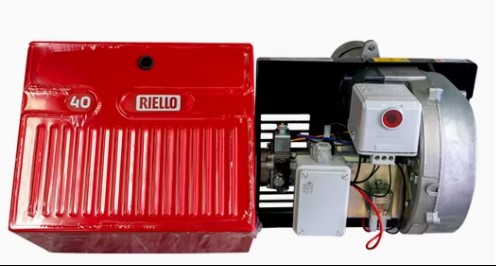
The quickest way is to send us a photo of the old nozzle and your burner’s rating plate. For example, Riello 40 G series burners such as the Riello 40 G10 use small light-oil nozzles. Larger heavy-oil burners, on the other hand, need bigger nozzles and a heated oil system.
For more on choosing the burner itself, read our oil burner in Mumbai guide.
Where can I buy an oil burner nozzle in Mumbai?
You can buy nozzles and other oil burner spares from Riello industrial oil and gas burners in Vasai (E). In addition, we ship across India. Also, browse our full product range.
So, send a photo of your old nozzle on WhatsApp at +91 98197 08885. Then we will match it and share the price.
Frequently asked questions
What do the numbers on an oil burner nozzle mean?
The first number is the flow rate in GPH. Then comes the spray angle, followed by a letter for the spray pattern.
Can I fit a bigger nozzle for more heat?
Not without advice. A bigger nozzle can overfire the burner, so ask a technician first.
How often should I change the nozzle?
Many plants change it at every yearly service. However, change it sooner if you see smoke or soot.
Are all nozzle pattern letters the same?
No. Each maker uses its own letters, so check the maker’s chart.
Where can I buy one?
Send a photo of your old nozzle on WhatsApp, and we will match it.
Contact us
Riello industrial oil and gas burners
Gala No. 204, B Block, Prime Trade Center, Waliv Phata, Sativali Road, Vasai (E) – 401208, Maharashtra
Find us on Google Maps