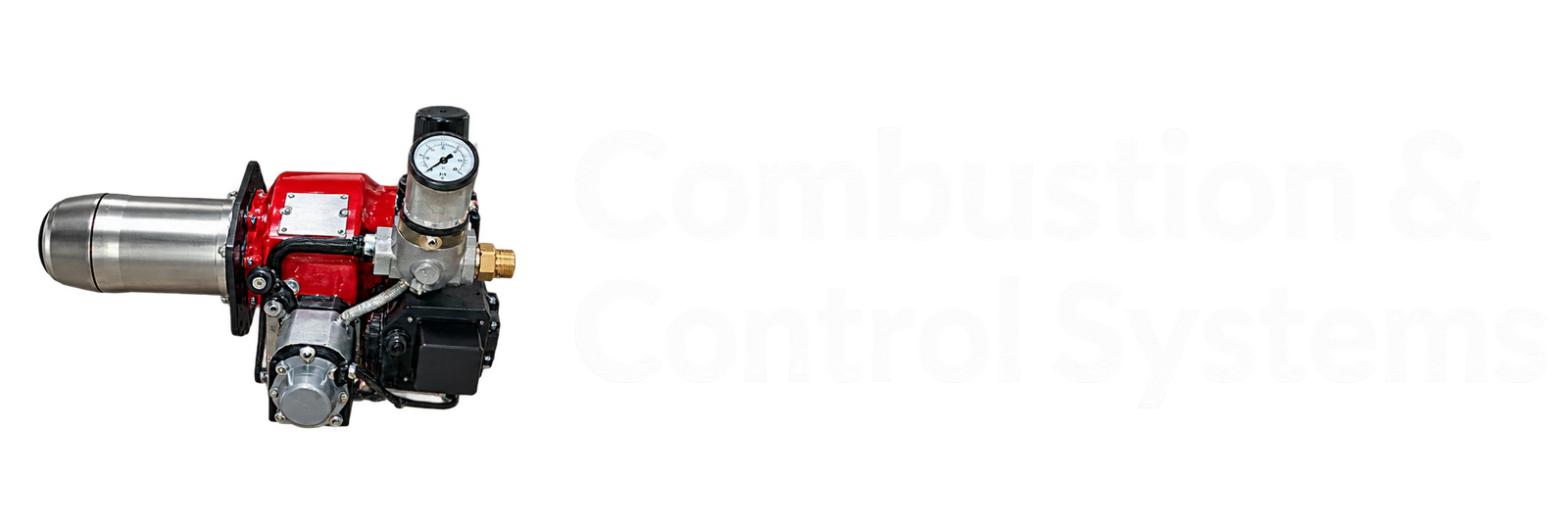
To choose the right Riello burner for your boiler, first find the heat input your boiler needs in kW. Then pick a model whose firing range covers that figure in the middle, not at the very top or bottom. For most small boilers, ovens and dryers in India, this means a model from the Riello 40 G (oil) or 40 FS (gas) range.

This guide shows you how to work out the kW figure in a few simple steps, even if your boiler plate only shows kg/h of steam or kcal/h.
Why does burner size matter so much?
If the Riello burner for your boiler is too small, it cannot give the boiler its full output. As a result, steam pressure drops when your plant needs it most.
On the other hand, an oversized burner is also a problem. The 40 G and 40 FS models are single-stage (on/off) burners. So a burner that is too big reaches temperature quickly, switches off, and then starts again a few minutes later. This short cycling wastes fuel, causes more soot and wears out the ignition parts, the motor and the control box faster.
What information do I need before I start?
Before you look for a Riello burner for your boiler, collect these details. In fact, a photo of the boiler name plate usually answers most of them.
- Boiler rating: heat input or output in kW, kcal/h, or steam output in kg/h
- Boiler efficiency: from the boiler maker’s data sheet, if available
- Fuel: diesel (HSD), natural gas (PNG) or LPG
- Old burner details: make, model and nozzle size, if you are replacing a burner
- Furnace size and blast tube opening: so the burner head fits correctly
- Power supply: confirm your site supply voltage (230 V single phase versions are common)
How do I convert my boiler rating into burner kW?
Your boiler rating can be shown in different units. Here is how to turn each one into the burner heat input you need.
1. Rating in kcal/h: divide by 860. For example, 1,00,000 kcal/h ÷ 860 = about 116 kW.
2. Rating in kW output (hot water boilers): divide the output by the boiler efficiency. For example, a 40 kW hot water boiler at 88% efficiency needs 40 ÷ 0.88 = about 45 kW of burner input.
3. Rating in kg/h of steam: as a rough rule, each kg/h of steam at normal working pressure needs about 0.7 kW of heat, starting from cold feed water. After that, divide by efficiency. For example, a 100 kg/h steam boiler needs about 70 kW of heat, and at 85% efficiency that becomes about 82 kW of burner input.
4. Using your present diesel consumption: Riello uses a net calorific value of 11.8 kWh per kg for light oil. So if your old burner burns 6 kg/h of diesel at full load, it is firing about 6 × 11.8 = 71 kW.
Finally, add a small margin of about 10% for start-up and dirty heat surfaces. Do not add more than this, because an oversized burner brings back the short-cycling problem.
Which Riello models cover which output?
Once you have your kW figure, match it to a model. The table below lists the firing ranges of the common single-stage models we deal with.
| Model | Fuel | Output range (kW) | Oil flow (kg/h) |
|---|---|---|---|
| Riello 40 G5 | Light oil / diesel | 28 – 60 | 2.3 – 5 |
| Riello 40 G10 | Light oil / diesel | 54 – 120 | 4.5 – 10 |
| Riello 40 G20 | Light oil / diesel | 95 – 213 | 8 – 18 |
| Riello 40 FS5 | Gas | 23 – 58 | – |
| Riello 40 FS10 | Gas | 42 – 116 | – |
| Riello 40 FS20 | Gas | 81 – 220 | – |
Oil burner figures are from the Riello 40 G brochure. Gas figures are for natural gas; for LPG, the burner needs the correct kit, so always mention your gas type.
Worked examples: which model would you choose?
- 45 kW hot water boiler input on diesel: this sits in the middle of the Riello 40 G5 oil burner range, so the G5 is a good fit.
- 82 kW for a 100 kg/h steam boiler on diesel: the Riello 40 G10 oil burner (54–120 kW) covers this with room on both sides.
- 116 kW oven on PNG: this is the very top of the FS10 range. Therefore, the FS20 is the safer choice, because it will not run flat out all day.
In other words, the best Riello burner for your boiler is the one where your figure lands comfortably inside the range.
What else can change the right choice?
The kW figure is the main step, but a few other points also matter.
- Furnace back-pressure: every Riello model has a firing curve that shows output against combustion chamber pressure. A boiler with high back-pressure can reduce the output you actually get.
- Head length: the blast tube must reach the right depth in the furnace. Some models have long-head (TL) versions for this.
- Gas supply pressure: for gas burners, the gas train and valve size depend on the pressure at your plant. For example, FS burners are often supplied with a Brahma EG12 SR GMO valve.
- Nozzle size on oil burners: the same G-series burner gives different outputs with different nozzles. So the nozzle must match your kW figure, not just the burner model.
Buy the right Riello burner for your boiler in Mumbai
You can get help choosing and buying from Riello industrial oil and gas burners, Gala No. 204, B Block, Prime Trade Center, Waliv Phata, Sativali Road, Vasai (E) – 401208, Maharashtra. We have worked with burners and combustion systems since 1996.
Simply send a photo of your boiler name plate, your fuel type and your old burner details. Then we will suggest a model and send a quote. You can also see our Riello 40 FS5, FS10 and FS20 gas burners.
[ADD: delivery time within Mumbai and to other cities]
Frequently asked questions
How many kW burner do I need for a 100 kg/h steam boiler?
Roughly 80–90 kW of burner input, depending on boiler efficiency and working pressure. On diesel, a Riello 40 G10 usually covers this.
Can I just buy a bigger burner to be safe?
No. A single-stage burner that is too large switches on and off too often. This wastes fuel and shortens the life of the parts.
How do I convert kcal/h into kW?
Divide kcal/h by 860. For example, 50,000 kcal/h is about 58 kW.
Can the same Riello burner work on diesel and gas?
No. The 40 G series is for light oil, while the 40 FS series is for gas. Choose the series that matches your fuel.
What should I send to get the right Riello burner for my boiler quoted?
Send a photo of the boiler name plate, the fuel type, the old burner model (if any) and the furnace opening size.